Human Vision Constrained Super-Resolution
Abstract
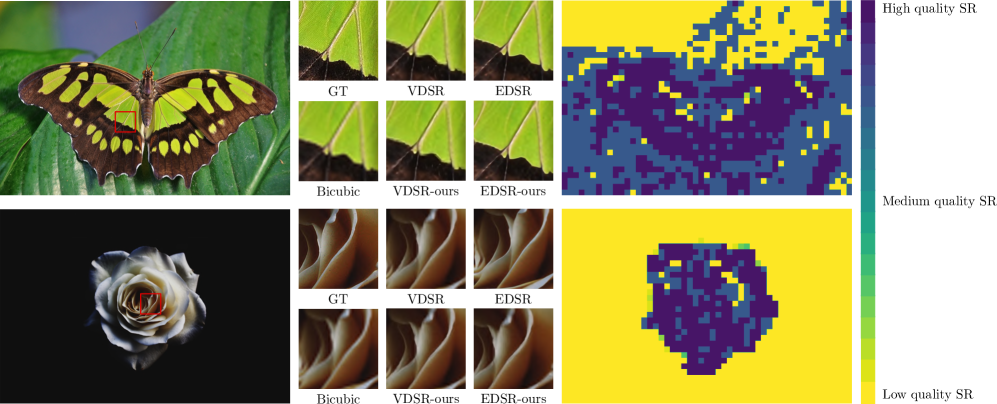
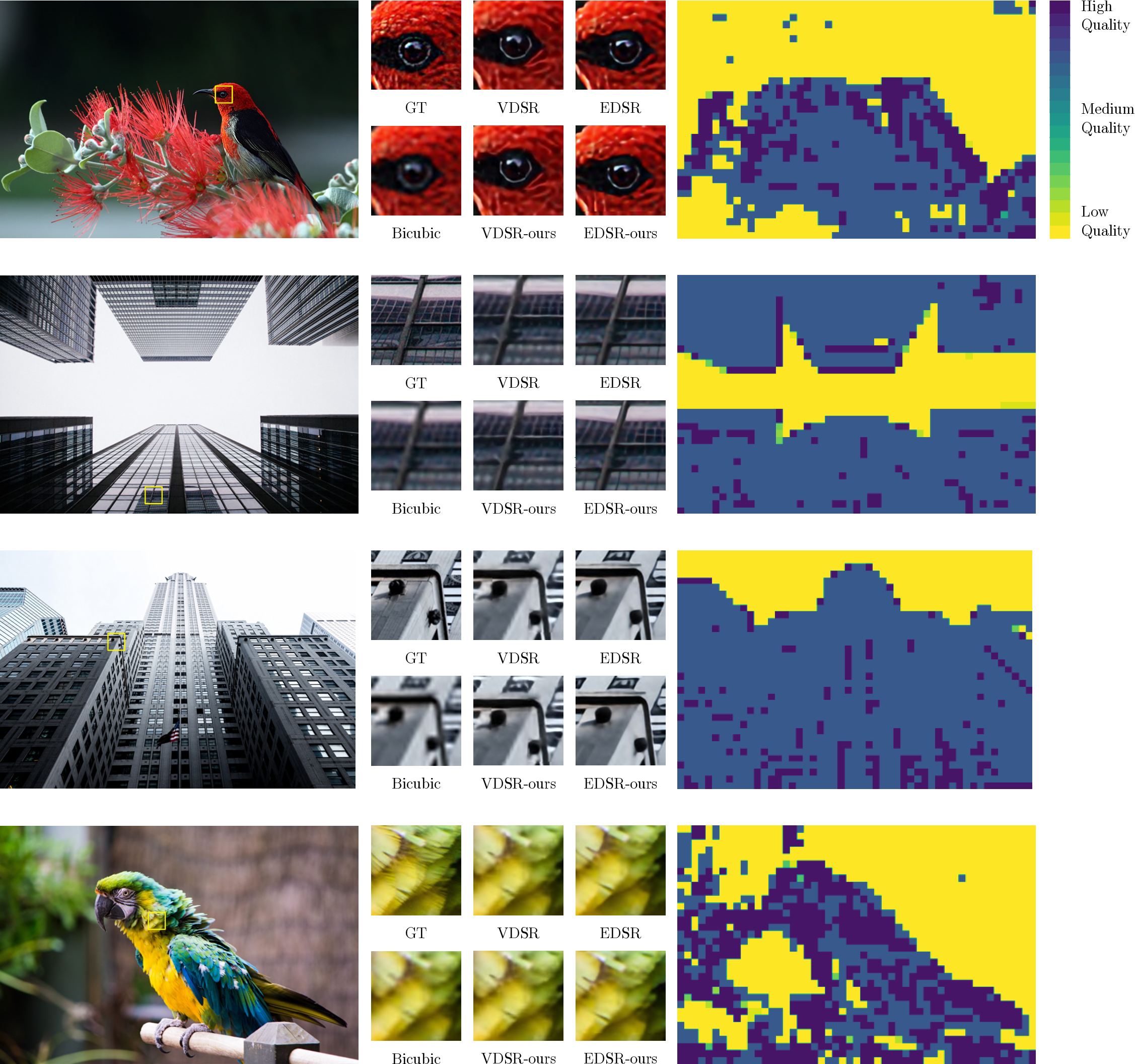
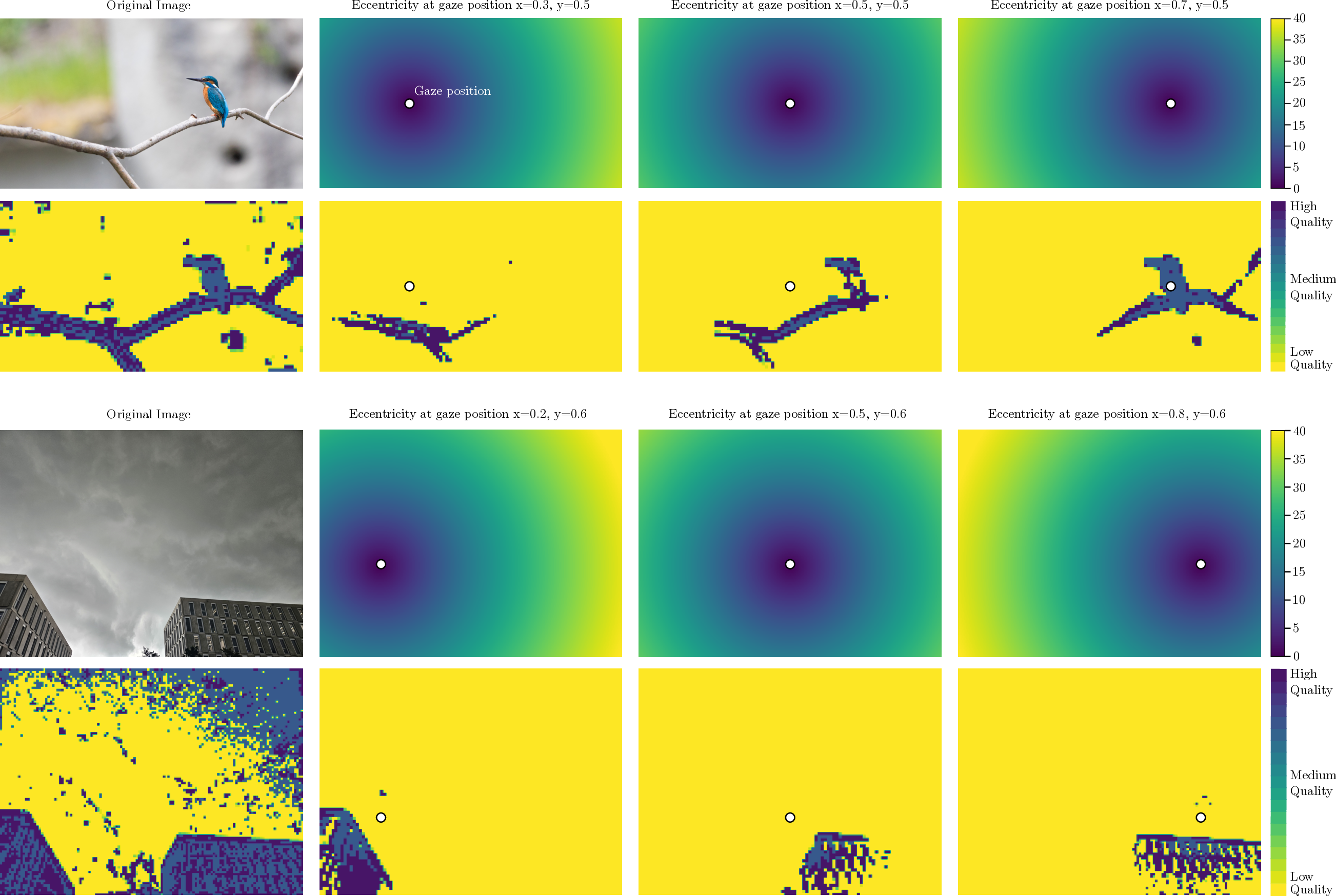
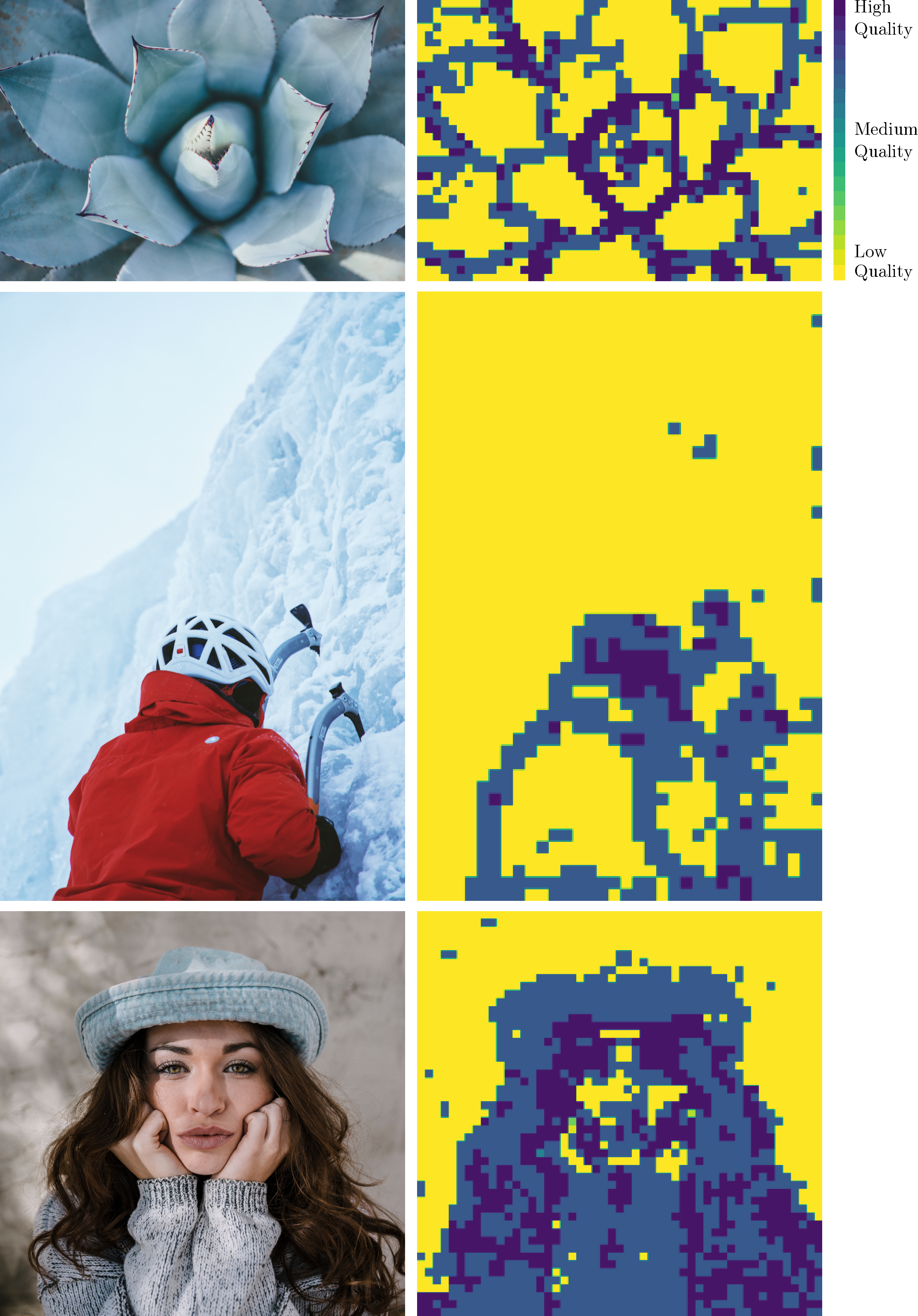
Modern deep-learning super-resolution (SR) techniques process images and videos independently of the underlying content and viewing conditions. However, the sensitivity of the human visual system (HVS) to image details changes depending on the underlying image characteristics, such as spatial frequency, luminance, color, contrast, or motion; as well viewing condition aspects such as ambient lighting and distance to the display. This observation suggests that computational resources spent on up-sampling images/videos may be wasted whenever a viewer cannot resolve the synthesized details i.e the resolution of details exceeds the resolving capability of human vision. Motivated by this observation, we propose a human vision inspired and architecture-agnostic approach for controlling SR techniques to deliver visually optimal results while limiting computational complexity. Its core is an explicit Human Visual Processing Framework (HVPF) that dynamically and locally guides SR methods according to human sensitivity to specific image details and viewing conditions. We demonstrate the application of our framework in combination with network branching to improve the computational efficiency of SR methods. Quantitative and qualitative evaluations, including user studies, demonstrate the effectiveness of our approach in reducing FLOPS by factors of 2× and greater, without sacrificing perceived quality.
Model Attenuation Curves
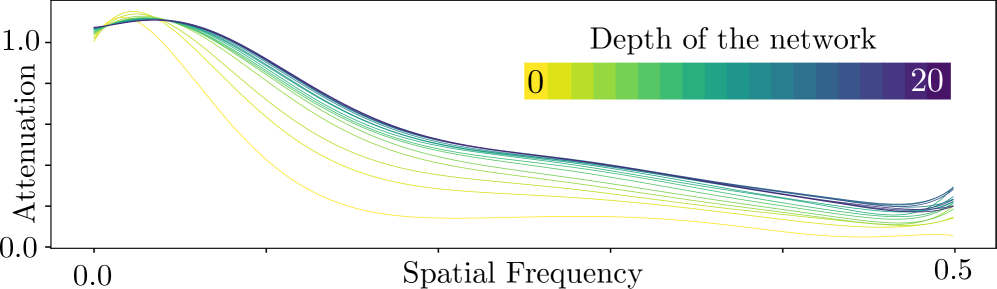
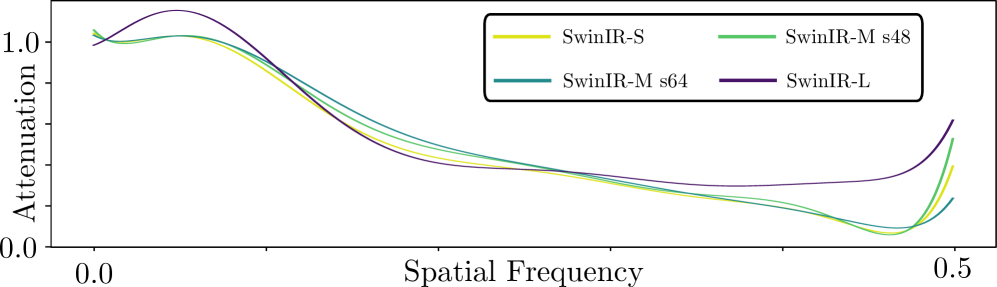
We use attenuation curves to characterize the reconstruction capability of different super-resolution models. By analyzing the radially averaged 2D Fourier transform of the up-scaled outputs against ground-truth images, we express the reconstruction power of each model or branch as a spatial-frequency response.
Method Predictions
VR Application
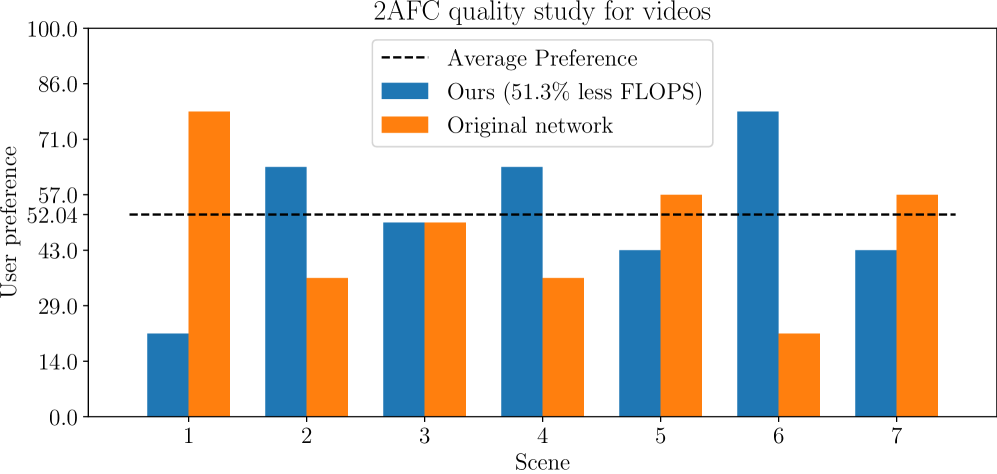
Video Super-Resolution (Temporal CSF)
To extend our Human Visual Processing Framework (HVPF) to video content, we model temporal contrast sensitivity by estimating the optical flow between frames. Since human visual sensitivity to spatial details decreases with motion velocity, we dynamically scale the spatial quality threshold in the foveation and contrast-sensitivity calculations. This allows for significant computational savings in high-motion regions without any human-perceptible degradation.
Quantitative Results (FLOPS Reduction)
We evaluate the computational efficiency of our method using average Floating Point Operations (FLOPS) as a machine-independent metric. By deploying simpler networks or shallower branches in visually insensitive regions, our perceptual model achieves massive speedups.
Predictor Model Overhead: The HVPF predictor model is designed to be extremely lightweight, introducing negligible overhead. Running the predictor costs only 39 KFLOPs for a \(10 \times 10\) patch and 477 KFLOPs for a \(35 \times 35\) patch. In real-time VR/AR applications, a full shader implementation of HVPF runs in under 1 ms at 2K resolution on standalone headsets like the Meta Quest 2.
| Application & Model | Dataset | Avg. FLOPS Savings | Subjective Study Size | Perceived Quality |
|---|---|---|---|---|
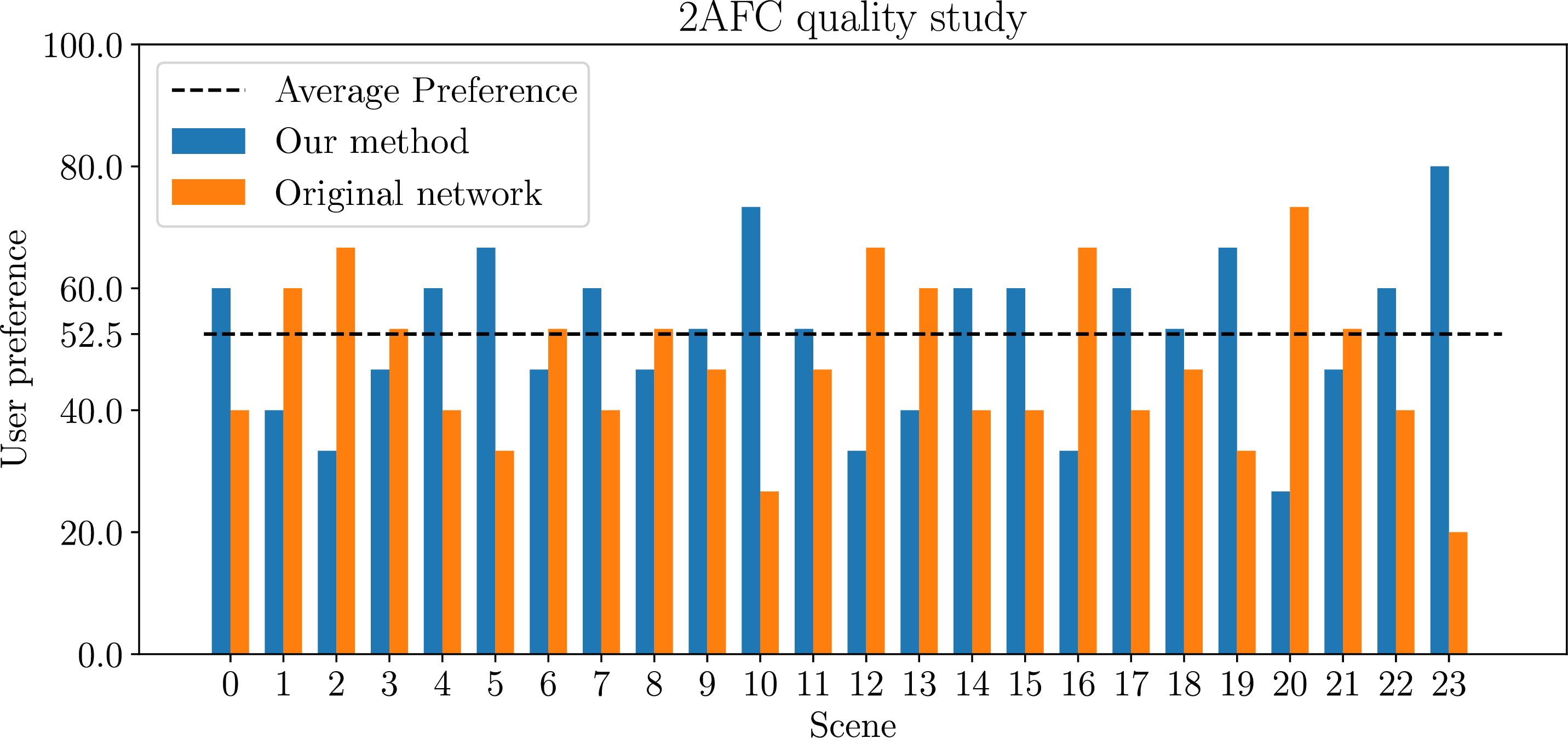
| VDSR Branching (Images) | Set5 & Set14 (24 natural scenes) | 30% - 80% | 15 participants | Indistinguishable (~50% pref) |
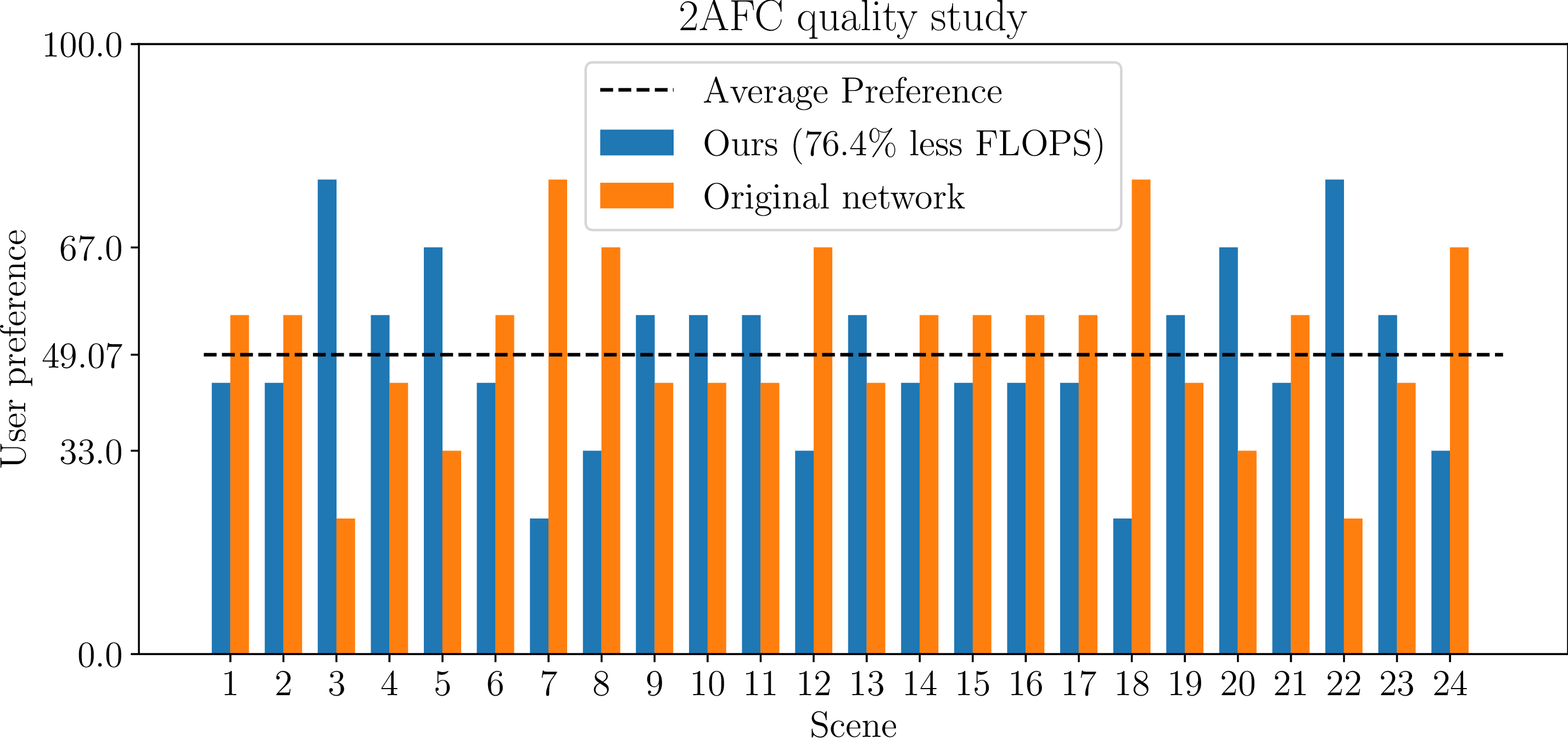
| EDSR Channel Depth (Images) | Set5 & Set14 (24 natural scenes) | 76.4% | 9 participants | Indistinguishable (~50% pref) |
| VDSR Branching (Videos) | Inter4K (7 natural videos) | 51.3% | 14 participants | Indistinguishable (~50% pref) |
Subjective Quality Studies (Images)
Additional Qualitative Results
Citation
@inproceedings{karpenko2025human,
    author    = {Karpenko, Volodymyr and Tariq, Taimoor and Condor, Jorge and Didyk, Piotr},
    title     = {Human Vision Constrained Super-Resolution},
    booktitle = {2025 IEEE/CVF International Conference on Computer Vision Workshops (ICCVW)},
    year      = {2025},
    pages     = {4782-4790},
    doi       = {10.1109/ICCVW69036.2025.00498},
    publisher = {IEEE},
    address   = {Honolulu, HI, USA},
    url       = {https://ieeexplore.ieee.org/document/11375594}
}